
EB plans to hire 8K workers this year and 8K next
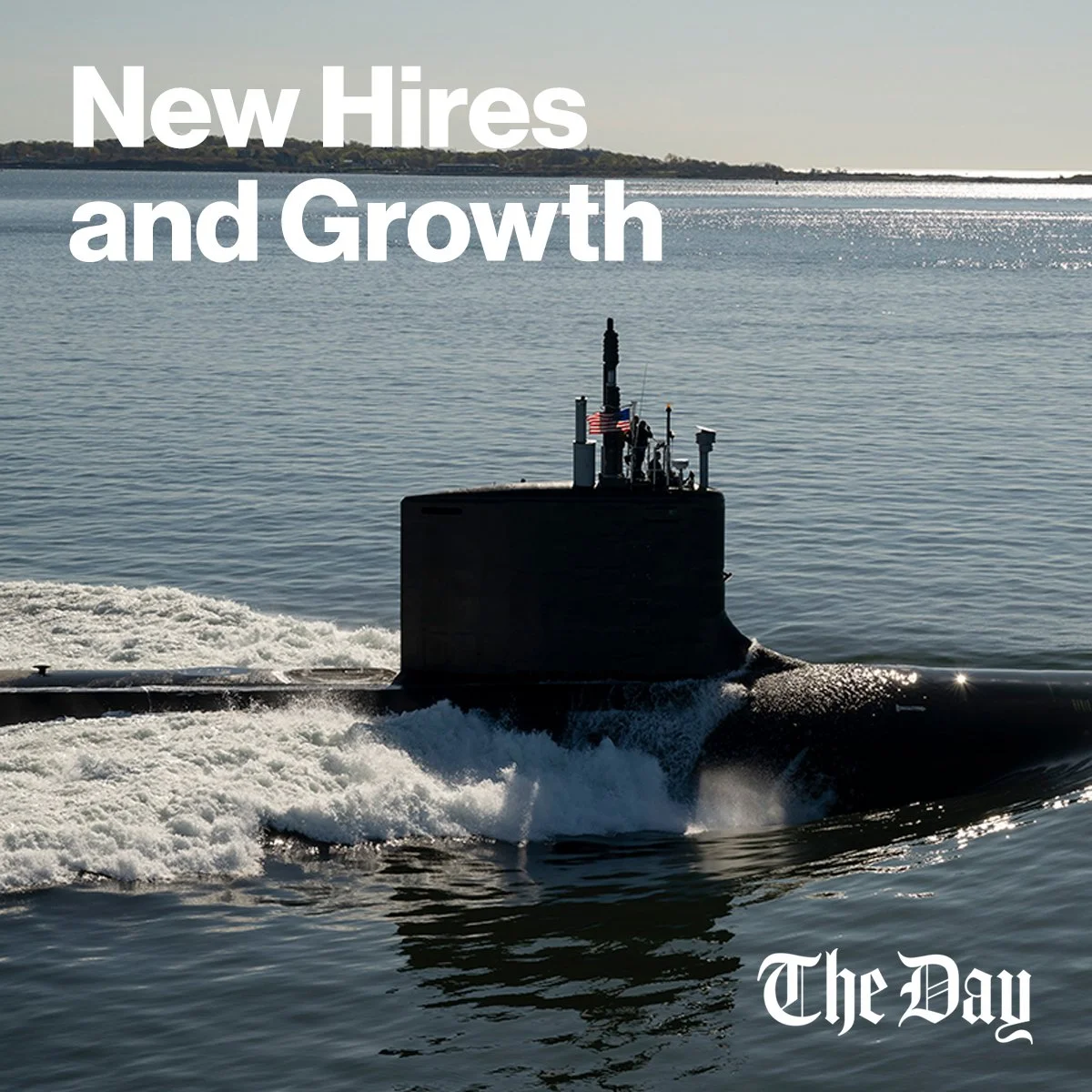
Groton — Electric Boat's president said Monday that the shipyard will be ramping up hiring by 8,000 both this year and next year as it continues to build capacity to deliver submarines at a faster rate.
"We are planning to keep this pipeline moving at about this pace for the next couple of years because we do need a lot of capacity," said Mark Rayha, EB's president, during a Legislative Breakfast attended by about 100 invited guests at the Mystic Marriott.
The Day reported last month that EB was planning to increase hiring from about 3,000 last year to 8,000 this year, but this was the first indication that the company was planning job growth at about the same pace in 2027 as well. Rayha said the hiring pace depended on a lot of factors, but "our view is that the more capacity we can create, the more the nation will buy and the more efficient we'll get."
Rayha said EB has had over 15,000 applicants for jobs during the past two years, and through February had hired 1,231 new employees this year. Much of EB's job growth last year, he said, was at Quonset Point, which saw nearly 1,800 new jobs compared to Groton's 515, while this year's increases will be spread out more evenly.
Projections this year call for 3,250 new jobs at Quonset Point and 2,250 in Groton. In addition, 1,000 new engineering and design jobs and 1,500 support personnel are expected to be added.
Congressional support
Growth has come thanks largely to congressional support, as Rayha acknowledged. U.S. Rep. Joe Courtney, D-2nd District, has been a stalwart advocate for EB as ranking member of the Seapower and Projection Forces Subcommittee, helping to raise funding for submarine manufacturing to $23 billion annually in 2025, far higher than the entire Navy shipbuilding budget two decades ago.
"Talk is cheap; budgets matter," Courtney said during a presentation at the 90-minute meeting also attended by U.S. Sen. Richard Blumenthal, D-Conn.
This year's budget will be supporting EB’s efforts to develop a workforce for the next generation of sub production. Congress also set aside funds to bolster pay rates for shipyard work, which allowed to company to offer 30% higher pay over the life of the contracts settled last year.
"What's happening right now is not just a blip," Courtney said. "The work is going to be going on for many, many decades."
Work this year focuses on delivering the Virginia-class fast-attack sub Hyman G. Rickover (SSN-795) in the first quarter, and completing the Virginia class fast-attack sub Utah (SSN-801) by either the end of the year or beginning of 2027, Rayha said. Other ongoing projects include the District of Columbia (SSBN-826), lead of the new Columbia-class ballistic-missile submarines, planned for 2028 delivery, and the fast-attack Virginia-class Arizona (SSN-803), expected that year as well.
Blumenthal, who is on the U.S. Senate Armed Services Committee, told invited state legislators and guests that submarines produced by EB are essential in today's world.
"We're in a literal arms race on submarines," he said. "We're ahead right now, but not necessarily forever if we take for granted our undersea superiority."
Growing pains
The ramp-up of production at EB has created some growing pains, of course, which showed up as state legislators who attended the meeting asked about how the company was dealing with such issues as workforce housing, parking and traffic.
Rayha noted that EB will add significantly to its parking capacity through its acquisition of the Crystal Mall in Waterford, though the number of spots there will do little more than satisfy the need of the 400 people who will work there within a couple years. After the meeting, Rayha also acknowledged that EB recently reached an agreement with Pfizer Inc. that will add nearly 700 parking spaces for employees in Groton. In addition, he said, the company is working on a plan to build a garage at a still-to-be-determined location in Groton that would accommodate about 1,000 vehicles.
He added, in response to a question, that he'd be open to the idea of a water taxi to help reduce traffic issues. He said he wasn't sure about the idea of adding flights to and from Washington, D.C., as it was not part of his expertise.
As for housing, Rayha acknowledged the need and said, "We are committed to helping in any way we can." The problem is not so much housing as it is affordability, he added.
Community engagement
In response to another question from Paul Whitescarver, executive director of the seCTer regional economic development agency, Rayha agreed that EB needs to do more to engage with the community, something that shrank in previous years as the business slowed down during the COVID-19 pandemic and subsequent supply-chain disruptions.
"We need to regrow that," he said, particularly its support of the United Way. "Hopefully, you'll start to see more and more of our prominence come through."
Rayha also acknowledged that EB had overlooked its workforce issues for several years. Now, he said, the company is very focused on developing shipyard workers for tomorrow, sponsoring periodic "signing days" for high school students who have gone through training programs to learn manufacturing skills.
In addition, the company has been investing heavily in local manufacturing facilities, an estimated $1 billion at Quonset Point and nearly $2 billion in the Groton area over the past few years. The projects have included a huge Virginia-class launch pontoon, an ATLAS floating drydock and the acquisition of the 800,000-square-foot Crystal Mall property. A Columbia pier construction project is slated to start this July.
"We continue to get better at EB," he said. "We continue to grow."